The effectiveness of myopia control strategies and the impact of the rebound phenomenon
Controlling myopia progression has become a clinical priority for eye-care professionals, given the continuous rise in the global prevalence of this condition. Therapeutic approaches—optical or pharmacological—can slow axial elongation and refractive progression, yet the effects observed after treatment discontinuation remain a key point of interest. A central aspect analysed in the scientific literature is the presence and magnitude of the rebound phenomenon, defined as an acceleration of myopia progression beyond the expected values for the child’s age and characteristics, occurring after therapy cessation.
Context and methodology
The scientific literature comprises numerous prospective clinical studies that evaluated myopia progression both during treatment and after its discontinuation. A recent analysis reviewed 19 clinical studies, including 24 treated groups. Inclusion criteria were strict: at least six months of treatment, a minimum of three months of follow-up after cessation, and the availability of axial length data to allow quantification of the rebound effect.
Some studies included control groups monitored throughout both the treatment phase and the post-treatment period, allowing direct comparison. Other studies used extrapolation models based on the natural course of myopia in untreated groups, adjusted for the age-related annual slowing typically observed with increasing age. For studies lasting less than one year, values were annualised to ensure standardised comparisons.
Results and observations
Data analysis reveals a nuanced view of the rebound phenomenon. The annualised mean rebound was:
- +0.05 ± 0.10 mm for axial elongation
- −0.09 ± 0.24 D for refractive progression
The two measures demonstrated a statistically significant correlation (r² = 0.59), confirming the direct relationship between structural ocular changes and refractive evolution. It was also observed that rebound correlates with first-year treatment efficacy (r² = 0.43): therapies with a stronger initial effect tend to present a higher risk of rebound after discontinuation.
Marked differences were noted between treatment types:
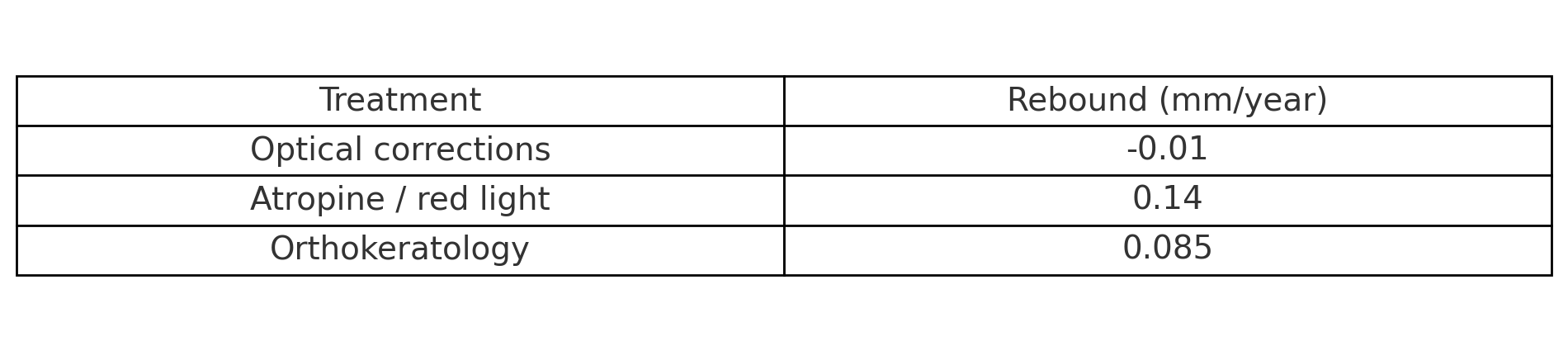
- Optical solutions for myopia control (specialty spectacle lenses and dedicated soft contact lenses) showed a practically negligible mean rebound (−0.01 ± 0.03 mm), indicating no evidence of post-treatment acceleration.
- Red-light therapy and atropine produced five of the highest rebound values (≥0.14 mm), suggesting increased sensitivity to abrupt discontinuation.
- Overnight orthokeratology showed variable values, between +0.03 and +0.14 mm, indicating a moderate but non-negligible rebound.
Interpretation and analysis
Discontinuing myopia control treatment is naturally associated with a temporary acceleration of progression, as the physiological mechanisms responsible for axial elongation are not eliminated but merely modulated while therapy is active. However, not all interventions exhibit the same rebound risk.
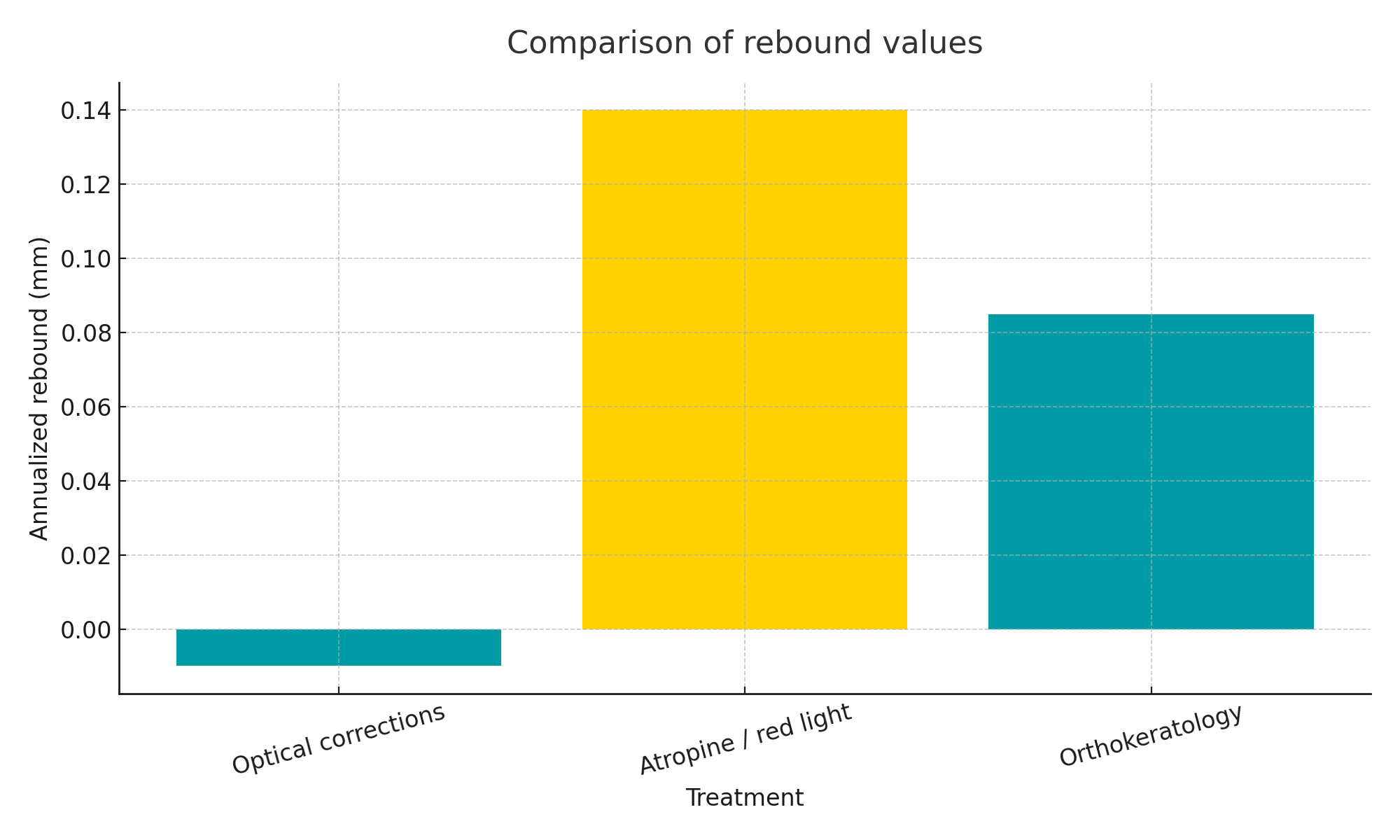
The absence of significant rebound with optical solutions suggests that these methods exert a more physiologically aligned form of control, introducing minimal disruption to natural ocular growth mechanisms. Conversely, pharmacological or photobiomodulation therapies—which influence complex biochemical pathways—may trigger a supracompetitive response upon cessation.
It is also notable that higher first-year treatment efficacy is associated with greater rebound magnitude. This may reflect an adaptive ocular mechanism: the more strongly an intervention suppresses natural progression, the more active growth pathways may become once treatment stops.
Practical implications
For eye-care professionals, these findings have direct implications for treatment planning and patient counselling:
- Post-treatment monitoring is essential, particularly for interventions with known rebound risk.
- Treatment duration should be individually adjusted, considering the child’s age, natural progression rate, and therapy type.
- Gradual transition strategies or continued use of optical methods after stopping pharmacological treatment may help reduce rebound—an avenue that warrants further research.
- Age at cessation may influence rebound severity, as younger children have a higher biological potential for axial growth.
In practice, clinicians can use these data to establish a close follow-up protocol in the first 6–12 months after treatment discontinuation, the period during which rebound is most likely to appear.
Conclusions
Current evidence indicates that rebound following the cessation of myopia control treatments is not a universal phenomenon and varies significantly depending on the type of intervention. Dedicated optical solutions do not exhibit meaningful rebound effects, whereas atropine and red-light therapies may lead to accelerated progression once stopped. Understanding these differences is essential for optimising therapeutic strategies and for effectively communicating with families of children undergoing myopia management.
Future research should examine in greater depth the role of age, treatment efficacy magnitude, and potential gradual discontinuation strategies that could minimise rebound risk.
Main source: analysis published in Ophthalmic and Physiological Optics.