IMI – defining and classifying myopia: a standardized framework for clinical practice and research
Over the past decades, myopia has become a major public health concern, with a rapidly increasing global prevalence and significant implications for visual function. As epidemiological data continue to indicate a steady upward trend, the precise and uniform definition of terminology used in the field has become essential. To ensure comparability across studies and to support the coherent application of clinical strategies, a unified set of standards for defining and classifying myopia is required.
Clarifying terminology
The scientific literature includes a large number of terms used to describe different forms of myopia, many of which overlap conceptually or are applied inconsistently. The IMI proposal simplifies the terminology and recommends the use of several core categories that support a logical and clinically applicable classification:
- Myopia – the refractive condition in which the image focuses in front of the retina when accommodation is relaxed.
- Axial myopia – primarily determined by excessive elongation of the anteroposterior axis of the globe.
- Refractive myopia – resulting from excessive optical power of the cornea and/or the crystalline lens.
- Secondary myopia – arising as a consequence of a specific cause, such as medication, systemic disease or distinct ocular pathology.
By adopting a reduced and well-defined set of terms, ambiguity is minimized and a foundation is created for consistent interpretation in clinical and epidemiological research.
Establishing quantitative thresholds
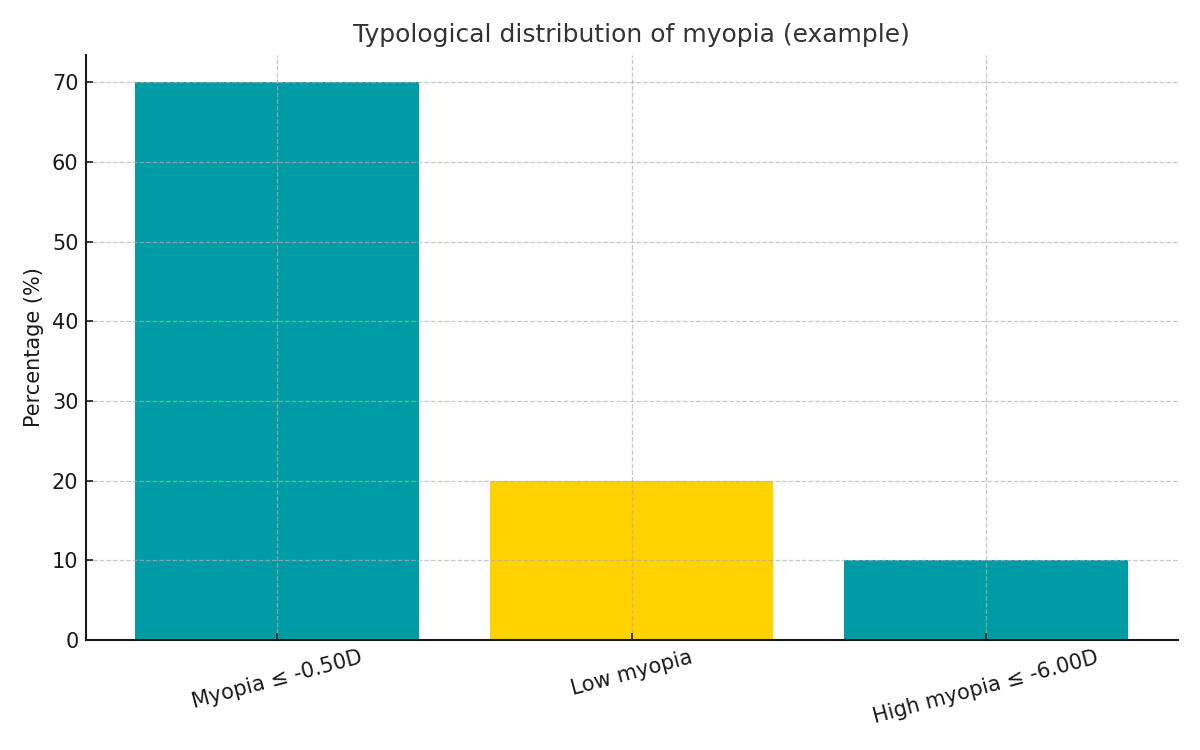
The classification of myopia also requires clear refractive thresholds, which ensure accurate patient inclusion in studies and support assessment of progression risk. Analyses of numerous international studies demonstrate consistent preference for the following thresholds:
- Pre-myopia: spherical equivalent error between +0.75 D and −0.50 D
- Low myopia: spherical equivalent ≤ −0.50 D and > −6.00 D
- High myopia: spherical equivalent ≤ −6.00 D
This classification system reflects both the global distribution of myopia prevalence and the associated risks. High myopia, in particular, is strongly correlated with a markedly increased likelihood of developing structural complications that may irreversibly impair visual acuity.
The concept of pre-myopia
To anticipate the onset of myopia in children and allow early preventive interventions, the concept of pre-myopia has been introduced. It refers to refractive states ranging from +0.75 D to −0.50 D that are associated with measurable risk factors such as age, rate of axial elongation, visual acuity, and family history. Longitudinal studies show that this refractive profile predisposes to the development of myopia, supporting close monitoring and, when appropriate, timely intervention.
Structural complications associated with myopia
Excessive axial elongation can generate significant anatomical changes that define pathologic myopia. This includes a broad spectrum of posterior segment alterations:
- posterior staphyloma
- chorioretinal atrophies
- myopic maculopathy
- lacquer cracks
- choroidal neovascularization
- macular retinoschisis or localized retinal detachment
- glaucoma-like optic neuropathy associated with high myopia
For consistent characterization of myopic maculopathy, the META-PM classification provides a structured system with five progressive levels, from tessellated fundus to advanced macular atrophy. This classification is widely used in international research due to its ability to differentiate disease stages with precision.
Practical implications
Implementing unified definitions and classifications has direct effects on clinical care and research quality:
- ensures valid comparison of epidemiological studies across populations;
- assists in early identification of children at increased risk of myopia;
- provides clear criteria for patient inclusion in myopia-control studies;
- supports systematic evaluation of ocular complications linked to high myopia;
- strengthens the foundation for public health policies focused on prevention.
For clinicians, integrating these standards represents a key step toward modern, evidence-based management of myopia in all its forms.
Conclusions
Adopting the definitions and classifications proposed by the IMI contributes to a shared understanding and coherent global approach to myopia. By reducing variability across studies and clearly defining refractive states and associated complications, these recommendations form a solid basis for developing effective strategies for prevention, diagnosis, and treatment.
Primary source: Flitcroft D.I. et al., IMI – Defining and Classifying Myopia: A Proposed Set of Standards for Clinical and Epidemiologic Studies, Investigative Ophthalmology & Visual Science, 2019.