Childhood-onset myopia management: evidence-based clinical analysis
Myopia represents one of the most significant ophthalmic public health challenges of the 21st century. Its continuously rising prevalence, combined with the increased risk of ocular pathology in adulthood, underscores the need for effective management strategies.
This article synthesizes current clinical evidence on myopia control interventions in children and adolescents, focusing on their efficacy, safety profile, and the criteria for treatment initiation and discontinuation.
Background and objectives
Childhood-onset myopia is increasing dramatically worldwide. It is estimated that by 2050, half of the global population will be myopic, with approximately 10% developing high myopia.
Early-onset cases (ages 6–13) are associated with faster progression and a higher likelihood of reaching pathologic myopia in adolescence.
The purpose of this article is to review the current clinical evidence for myopia management approaches, compare their efficacy, and discuss the practical implications for vision care professionals.
Risk factors and environmental optimization
Longitudinal studies consistently demonstrate that greater exposure to natural light reduces the risk of developing myopia. Children who spend at least two hours per day outdoors show a markedly lower incidence of onset.
Conversely, intensive near work, prolonged digital device use, and sustained near visual demand increase the risk of myopic progression. While evidence supporting a reduction in near work as a preventive measure is limited, optimizing the visual environment remains a cornerstone of prevention.
Therapeutic options
Myopia management contact lenses
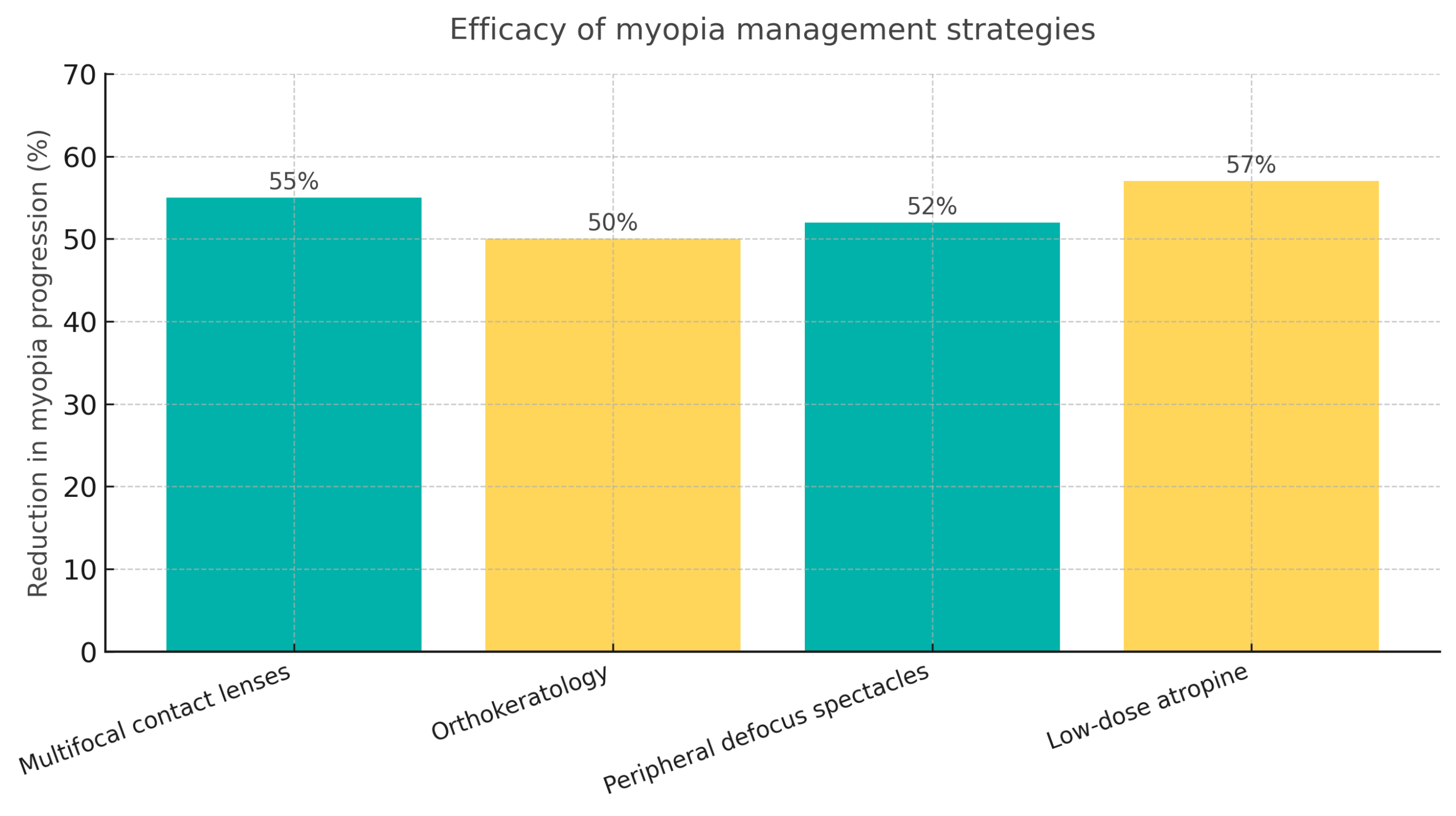
Soft multifocal and orthokeratology (ortho-k) contact lenses have been shown to reduce myopia progression by 40–60% over 1–3 years compared with standard single-vision correction. The effect is most pronounced during the first 12–18 months of treatment.
These interventions function through peripheral myopic defocus, a mechanism known to inhibit axial elongation.
The incidence of corneal inflammatory events in children is comparable to—or even lower than—that in adults, provided appropriate hygiene and lens-handling protocols are followed.
Myopia management spectacle lenses
Specially designed peripheral-defocus spectacle lenses constitute a safe and effective alternative, producing up to a 50% reduction in dioptric progression and a 60% reduction in axial elongation.
Conventional bifocal or progressive addition lenses have not demonstrated clinically significant benefits.
Pharmacological therapy
Low-dose atropine (0.01–0.05%) therapy has shown comparable efficacy, reducing myopia progression by approximately 50%.
In vitro studies suggest that atropine increases scleral stiffness and enhances choroidal blood flow, thereby limiting axial elongation.
In the United Kingdom and several European countries, its use remains off-label, though ongoing research may lead to formal authorization of pediatric formulations.
Comparative efficacy of management strategies
When comparing major treatment modalities, orthokeratology, multifocal contact lenses, and myopia-control spectacle lenses show similar effectiveness in reducing axial elongation.
Combination therapies (e.g., ortho-k with atropine) may achieve up to 60% reduction rates, though evidence remains limited.
These results support an individualized approach, considering age, refractive status, and rate of progression.
Treatment initiation criteria
According to the International Myopia Institute (IMI), intervention is warranted for children with myopia of –0.50 D or greater and documented progression.
Data indicate that most clinicians initiate management between –0.50 D and –1.00 D—an optimal threshold to prevent high-risk levels during adolescence.
Early intervention enables more effective control of axial growth and reduces the likelihood of developing high myopia.

Duration of treatment and monitoring
The optimal treatment duration remains uncertain. Current evidence supports continuation until refractive error and axial length stabilization, typically between ages 18 and 20.
According to the World Council of Optometry, wearing myopia management spectacles represents an appropriate solution until late adolescence, or shortly thereafter, approximately between 18 and 20 years of age.
After discontinuation, a temporary increase in axial elongation (“rebound effect”) may occur, warranting refractive and biometric monitoring at 6 and 12 months post-treatment.

Monitoring protocols should be adapted according to individual history and therapeutic response.
Safety considerations
Recent systematic reviews confirm the favorable safety profile of myopia management contact lenses in children.
The incidence of corneal events is low, and orthokeratology lenses do not present additional risks compared to other overnight wear modalities.
Spectacle-based interventions are also considered safe, posing no additional hazards relative to standard optical correction.
Clinical implications and future perspectives
Although direct evidence linking reduced myopia progression to lower incidence of sight-threatening diseases is lacking, decreasing axial length is associated with a reduced relative risk of myopic maculopathy, glaucoma, and retinal detachment.
Effective long-term myopia control can enhance patients’ quality of life by decreasing dependence on optical correction and lowering the risk of irreversible ocular complications.
Conclusions
Childhood myopia management is a key component of modern optometric and ophthalmologic practice.
The combined efficacy of optical and pharmacological therapies offers real potential for controlling disease progression, with substantial benefits for long-term visual health.
Implementing structured monitoring programs and tailoring treatment to each patient’s clinical profile are essential for achieving optimal outcomes.
Source: The College of Optometrists, “Childhood-onset myopia management: Evidence review”, published August 2022.