The effects of myopia undercorrection on refractive progression in children
The management of optical correction in children with myopia has long generated debate regarding the impact of various strategies on refractive development. One such strategy is intentional undercorrection, based on the premise that reducing lens power could slow eye growth by diminishing the hyperopic defocus signal. The study conducted by Chung, Mohidin, and O’Leary in 2002 provides one of the most rigorous clinical evaluations on this subject, examining the effect of undercorrection on myopia progression in children aged 9 to 14 years.
Context and methodology
The biological mechanism guiding the refractive development of the eye—emmetropization—depends on the visual system’s ability to distinguish between myopic and hyperopic defocus. Under normal conditions, the eye adjusts its growth so that the retinal image is formed without refractive error. In children who develop myopia, it is presumed that this sign-detection mechanism becomes dysfunctional. As a result, image blur may trigger an abnormal axial elongation response, even in situations where an inhibitory effect on growth would normally be expected.
To evaluate this hypothesis, the study monitored a cohort of 94 myopic children over a period of two years, divided into two groups: an undercorrected group and a fully corrected group. Children in the undercorrected group wore spectacles that reduced their distance visual acuity to approximately 6/12, typically achieved by adding +0.75 D relative to full correction. The control group received full correction, maintaining visual acuity at 6/6 or better.
All participants underwent standardized optometric evaluations every six months, including cycloplegic refraction, measurement of ocular components, and monitoring of spectacle-wearing compliance.
The baseline characteristics of the two groups are summarized in the table below.

Results and observations
Differences between the two groups became evident over the 24-month monitoring period. According to the published data, the mean myopia progression in the undercorrected group was –1.00 D, whereas in the fully corrected group it was –0.77 D. This difference was statistically significant.
The evolution of refractive error over the 24 months is illustrated in the graph below.

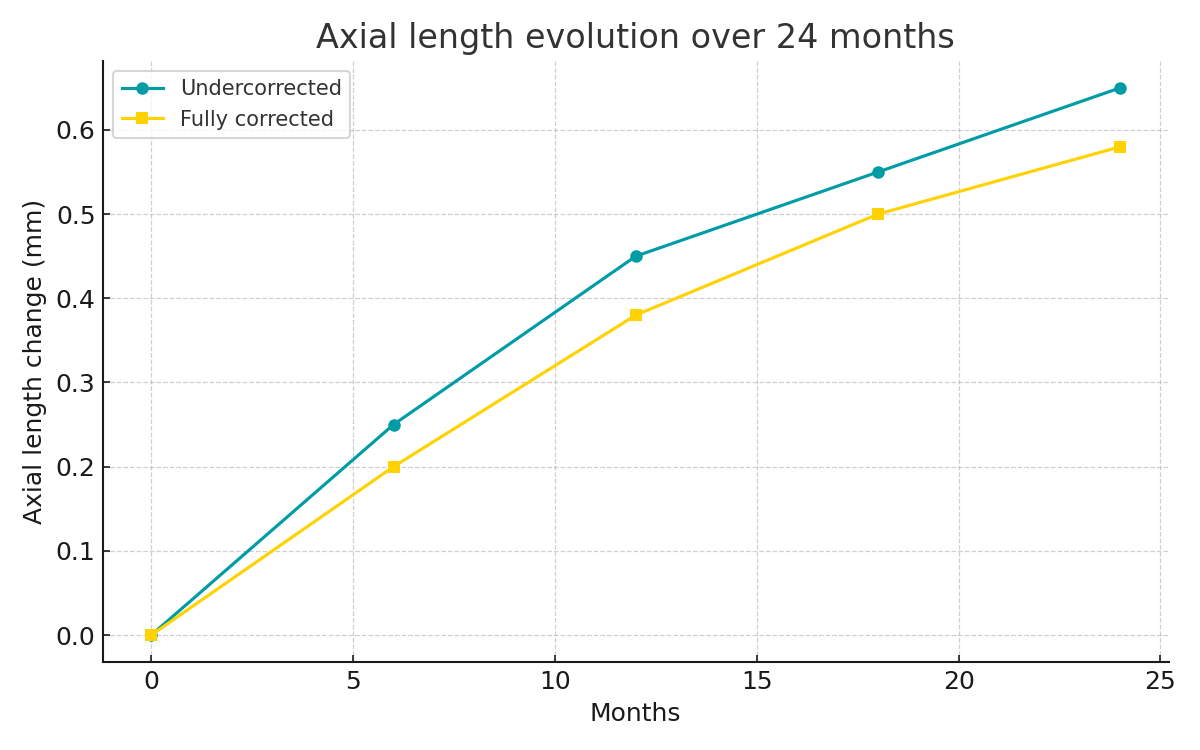
A similar pattern was observed with respect to axial elongation: children in the undercorrected group exhibited more pronounced axial length increases than those receiving full correction. Other ocular components, such as corneal curvature, lens thickness, or anterior chamber depth, did not show relevant differences between groups.
Axial length changes are presented in the following graph.
Importantly, both groups demonstrated similar levels of spectacle-wearing compliance, ruling out intermittent use as a confounding factor.
Analysis and interpretation
The results indicate that undercorrection not only fails to slow myopic progression but may actually accelerate it. This conclusion contradicts hypotheses suggesting that undercorrection would reduce hyperopic defocus signals and limit axial elongation. Instead, the study suggests that in already myopic eyes, any form of blur—regardless of sign—can stimulate growth.
These findings are consistent with other research showing that accommodative responses in myopic children are often insufficient when faced with induced defocus. This diminished response suggests an impaired ability to accurately detect the sign of defocus—an essential mechanism for appropriate accommodative adjustment. In this context, undercorrection may amplify the error signal and, consequently, myopic progression.
By comparison, optical strategies that maintain optimal distance acuity while reducing accommodative demand at near—such as progressive addition lenses for children predisposed to rapid progression—have demonstrated moderate beneficial effects in other studies.
Practical implications
For practitioners in optometry and ophthalmology, the study’s conclusions provide strong evidence against the use of undercorrection in children with myopia. Although historically considered a simple and potentially protective approach, current evidence suggests the opposite: image clarity plays a critical role in maintaining optimal control over ocular growth.
In clinical practice, full correction remains the recommended standard. Moreover, for children at high risk of progression, modern optical solutions—such as lenses designed specifically for myopia management—may represent safer and more effective alternatives.
When using optical devices intended for myopia control, such as lenses engineered to reduce peripheral defocus, they should be integrated into a comprehensive evaluation and monitoring plan, based on objective clinical data and strict adherence to wear-time recommendations.
Conclusions
The study by Chung and colleagues clearly demonstrates that undercorrection accelerates myopia progression in children. This phenomenon appears to be related to a defective mechanism for interpreting defocus in myopic eyes, causing the presence of blur—even within existing myopia—to stimulate axial elongation.
For professionals in the field of optical health, these findings emphasize the need to maintain precise and stable correction, as well as to recommend scientifically validated optical treatments for myopia control, avoiding strategies that may worsen progression.
Primary source: Chung, K., Mohidin, N., & O’Leary, D. (2002). Undercorrection of myopia enhances rather than inhibits myopia progression. Vision Research, 42, 2555–2559.