Myopia progression in children: differences between Asian and European populations
Myopia represents a growing public health concern worldwide, with major implications for quality of life and risks such as cataract, glaucoma, and retinal detachment. In recent years, numerous studies have reported an increasing incidence of myopia, particularly in urban environments and among children of Asian origin. In this context, a meta-analysis conducted by Donovan and colleagues (2012) evaluated the rate of myopia progression in urban children wearing single-vision lenses, comparing Asian and predominantly European groups.
Context and methodology
The analysis included 20 studies published between 1990 and 2009, selected based on strict criteria: children under 16 years of age, cycloplegic refraction measurements, use of autorefractometry, and exclusive correction with single-vision lenses. Studies with small samples, rural populations, or non-randomized designs were excluded.
In total, 2,194 children aged between 7 and 12 years were analyzed. The data were weighted according to sample size and follow-up duration, using linear mixed statistical models to estimate the annual rate of progression in diopters (D) as a function of age, sex, and ethnicity.
Main results
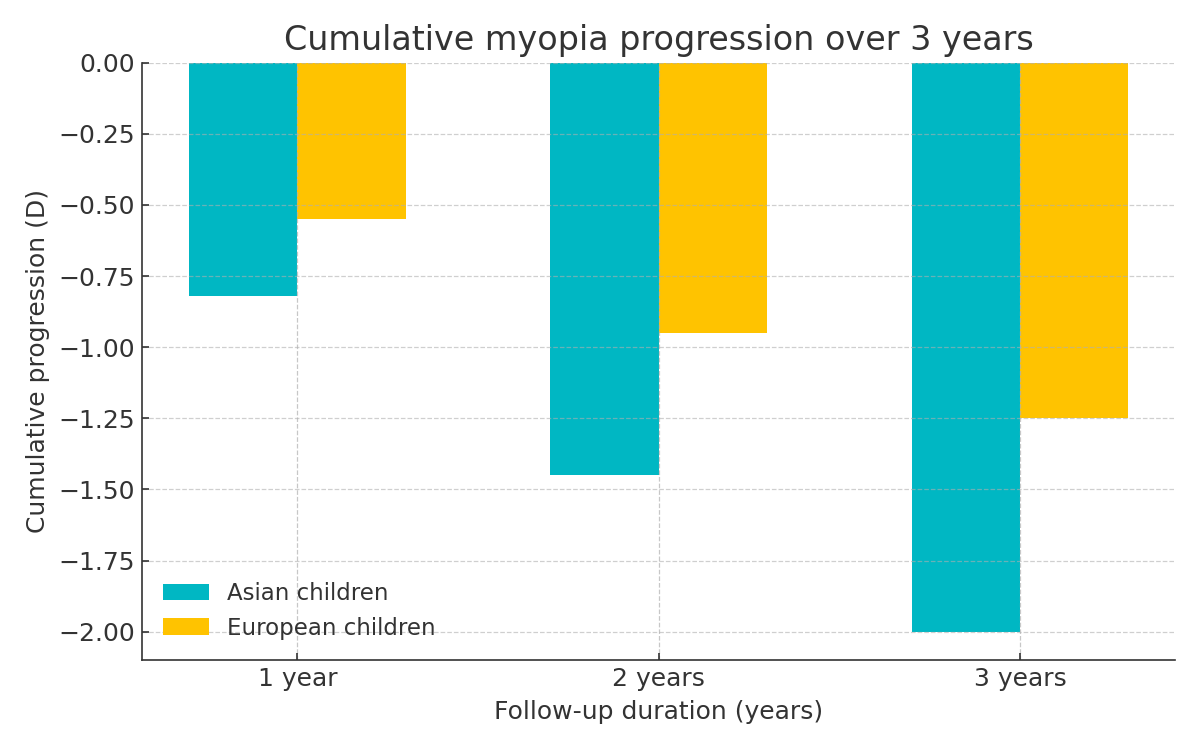
Myopia progression was significantly faster in Asian children than in those of European origin. After three years of follow-up, the cumulative difference between the two groups was approximately 0.6 D, indicating a more accelerated evolution of myopia in urban Asian populations.
- Average annual progression rate:
- European children: −0.55 D/year (95% CI: −0.39 to −0.72 D)
- Asian children: −0.82 D/year (95% CI: −0.71 to −0.93 D)
- Effect of age: the progression rate decreases with increasing age, following a curvilinear pattern.
- Gender differences: girls showed a slightly higher progression rate (−0.80 D/year) compared with boys (−0.71 D/year), a statistically significant difference (p < 0.01).

Analysis and interpretation
The results show a clear correlation between ethnicity and myopia progression. In urban Asian populations, myopia not only begins earlier but also progresses more rapidly. These differences may be influenced by both genetic factors and lifestyle characteristics such as intense near work, high academic pressure, and limited time spent outdoors.
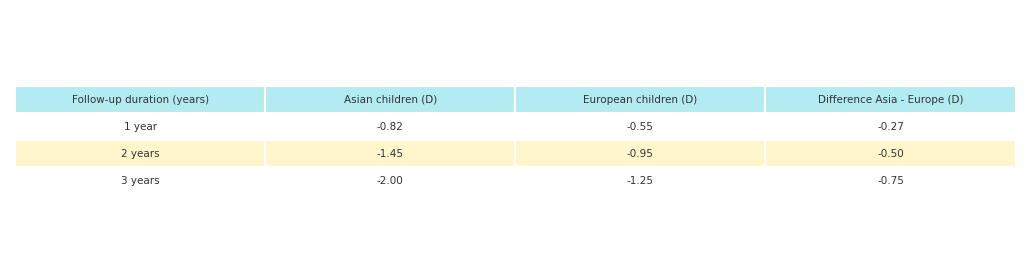
It is important to note that for Asian children, the average progression over three years is approximately −2.0 D, compared with −1.25 D for European children. Although this annual difference appears modest, it has significant long-term clinical implications, increasing the risk of high myopia and subsequent ocular complications.
Clinical and practical implications
For professionals in optometry and ophthalmology, these findings highlight the need for differentiated strategies for monitoring and controlling myopia, tailored to the patient’s ethnic profile and age.
Practical recommendations:
- Implement early screening programs in high-risk populations (for example, urban Asian children).
- Schedule follow-up examinations at shorter intervals for children with early-onset myopia.
- Integrate myopia control therapies (such as multifocal lenses, low-dose atropine, or orthokeratology lenses) into individualized management plans.
Conclusions
The meta-analysis conducted by Donovan et al. (2012) demonstrates that myopia progression is significantly faster in urban Asian children compared to those of European origin. The main determinants include younger age at onset and female sex, both associated with a more rapid evolution.
For vision care professionals, these conclusions emphasize the importance of personalized management based on the assessment of ethnic risk, age, and environmental factors, to help prevent the development of severe myopia.
Based on the study conducted by Donovan L. et al., published in Optometry and Vision Science, 2012, Vol. 89(1), pp. 27–32.