


Myopia in Children
Can It Be Cured?
Can myopia in children be cured? A realistic point of view

The question “Can myopia in children be cured?” comes up very often among parents. To begin with, it’s important to clarify one key point: myopia cannot be “cured” during childhood.
A child’s vision can be corrected with glasses or contact lenses to see clearly now, and the progression of myopia can be controlled with special treatments so that the diopters increase more slowly. What truly matters is to act early and choose the solution that best fits your child.
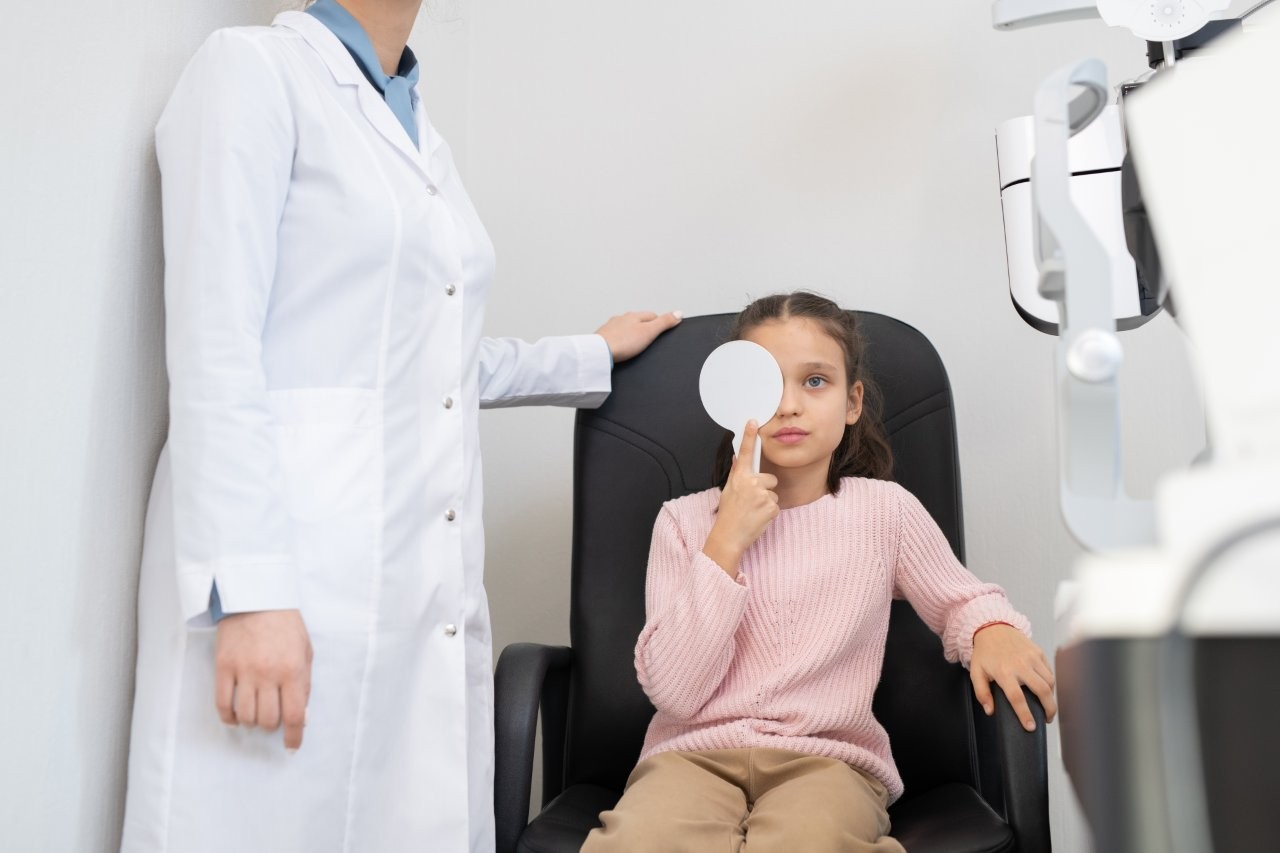
Myopia occurs because the eye grows longer than normal and the image focuses in front of the retina. Glasses and contact lenses correct vision, but they do not stop this tendency. That’s why we cannot speak of a complete “cure,” but rather of myopia management: careful monitoring and methods that slow down progression.
Why there is no “cure” in childhood

Today, several options have been tested in international studies:
- Special glasses with defocus zones – can slow the increase in prescription compared to regular glasses
- Dual-focus contact lenses – provide good correction and have proven effective long-term in reducing myopia progression
- Orthokeratology (Ortho-K) – lenses worn at night that provide clear vision during the day while slowing eye elongation
- Low-dose atropine – drops applied in the evening, with proven effectiveness in many cases
What methods have proven effective in children

None of these methods “erase” myopia, but all can make a real difference in how quickly the problem progresses. Clinical studies lasting 1–2 years have confirmed that the benefits of these special glasses are sustained, not just temporary. Myopia progression remains significantly slower than in children with standard glasses, which gives parents the reassurance that it is not just a short-term effect.
How to choose the right solution
There is no one-size-fits-all recipe for every child. The choice depends on:
- The child’s age
- How quickly myopia is progressing
- Lifestyle and preferences (glasses, contact lenses, sports activities)
- The doctor’s experience
Talk openly with the specialist about what suits your child and about realistic expectations for each option.
What you can do at home right now
In addition to treatments, a few simple habits can help a lot:
- Encourage your child to spend about two hours a day outdoors
- Set regular breaks from homework and screens (the 20-20 rule: every 20 minutes, 20 seconds looking into the distance)
- Maintain proper reading and screen distance (40–45 cm for books, arm’s length for monitors)
- Ensure proper lighting at the desk
These measures don’t stop myopia, but they make it easier to manage day by day.
When should you be concerned
It’s a good idea to see an eye doctor:
- As soon as you notice your child squinting, moving close to screens, or complaining of headaches
- If prescriptions increase quickly (more than 0.5–1 diopter per year)
- If there are cases of myopia in the family
FAQ
Is there a chance myopia will disappear during adolescence?
No. Myopia doesn’t go away, although progression may slow toward the end of the growth period.
Is it dangerous for a child to wear contact lenses?
No, as long as they are chosen correctly and used with good hygiene. The doctor will guide you to the safest type.
Does atropine have side effects?
At the low concentrations used for myopia control, side effects are rare and mild (slight light sensitivity, sometimes minor difficulty with near vision).
You can’t cure it, but you can control its progression
Childhood myopia cannot be cured, but it can be corrected and managed. With modern treatments and healthy habits, your child can enjoy clear vision while significantly lowering the risk of long-term complications. What matters most is starting early and working together with the doctor to find the right solution.
Childhood myopia: Tips and innovations from Avvero

Myopia in children: what it is, why it appears, and how to manage it properly

Understanding the Causes of Myopia in Children

Discover Avvero’s initiative for managing childhood myopia, together with Myolino.
Myopia in children: symptoms, prevention, and natural treatments
Myopia can appear even at an early age, sometimes as young as 3 years old, and the first signs are often noticed by parents. Although there are no natural remedies that can cure myopia, healthy habits — a balanced diet, time spent outdoors, and limited screen use — can support medical treatment. With regular eye check-ups and active parental involvement, a child’s vision can be protected in the long term.

Special lenses for children: what innovative options exist and how to choose wisely
Special lenses for children with myopia provide not only clear vision but also long-term protection. With innovative designs such as MyoLess, they can slow the progression of myopia and reduce eye strain. Adapted to the child’s age and lifestyle, they combine everyday comfort with real, lasting benefits for eye health.
High myopia in children: what solutions exist and which lenses help
When a child has high myopia, modern solutions are needed to provide clarity and slow the progression of the condition. Special lenses for myopia control, such as MyoLess, can reduce the increase in diopters and protect vision in the long term. With regular medical monitoring and healthy daily habits, the child can maintain healthy eyes and stable vision over time.

Treatment for myopia in children: safe and effective options
More and more parents are looking for modern solutions to correct their children’s myopia, and today’s treatments offer safe and effective options. Special glasses, contact lenses, or atropine treatments can be tailored to each child, depending on age and the degree of myopia. With proper medical supervision and healthy daily habits, vision can remain clear and stable in the long term.

Correcting myopia in children: safe methods and how to choose
At the age when a child is diagnosed with myopia, the natural question for parents is: “How can we correct their vision and stop the problem from progressing?” Correction doesn’t mean a cure, but rather methods that provide clear sight now and slow down long-term progression. Special glasses, contact lenses, atropine treatments, or overnight lenses — all can be adapted to the child’s age and lifestyle. With the doctor’s guidance and the parents’ daily involvement, a child’s vision can be protected for years to come.

Myopia in 7-year-old children: how to recognize the signs and solutions
At the age of 7, some children start to see poorly at a distance, and parents may notice that they sit too close to the board or the screen. Early-onset myopia can progress quickly, but the good news is that there are effective solutions — special glasses, safe treatments, and healthy daily habits. With the help of doctors and parents, a child’s vision can be protected in the long term.